


Here we are going down the Gulf Coast of Texas: Free ferry to North Padre Island (mostly private; S Padre is mostly National Seashore). There are lots of sharks along here, but they never actually bite people (honest)!
 Texas State Aquarioum at Corpus Christi: They have some neat animals here - ocelot:

Got him to do a few tricks:
 Other animals need more persuading:

Turkey Buzzard. Fascinating fact: The reaons there're no feathers on the head is that, since they eat things that are thoroughly dead, they might get some really yucky stuff on their head---
 A Kestrel - they migrate.

Barn owl - looks like he's up past his bedtime---

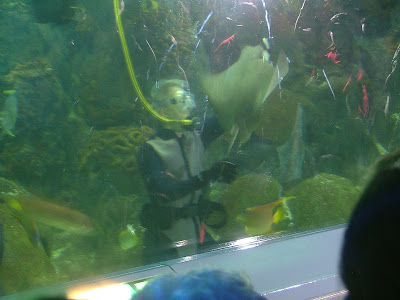
Feeding the fish, up close and personal:
Up close and personal with one of the dolphins:

And, Texas State Botanical Garden: No, they didn't try to sell us insurance -
 Texas Museum of Science & History: a copy of the Pinta, one of Columbus' ships. The Spanish Govt sent replicas of all three on a tour over here on the 500th anniversary, in 1992. The response here, for some reason, was sensational, better then anywhere else, so the Spanish govt left them here. Unfortunately, all three are badly deteriorated; Neat anyway. These ships are not very big! Had to be determined to sail who-knows-how-far in one.

 There are lots of sharks along here, but they never actually bite people (honest)!
 Texas State Aquarioum at Corpus Christi: They have some neat animals here - ocelot:
Got him to do a few tricks:
 Other animals need more persuading:
Turkey Buzzard. Fascinating fact: The reaons there're no feathers on the head is that, since they eat things that are thoroughly dead, they might get some really yucky stuff on their head---
 A Kestrel - they migrate.
Barn owl - looks like he's up past his bedtime---

Feeding the fish, up close and personal:

Up close and personal with one of the dolphins:

And, Texas State Botanical Garden: No, they didn't try to sell us insurance -
Texas Museum of Science & History: a copy of the Pinta, one of Columbus' ships. The Spanish Govt sent replicas of all three on a tour over here on the 500th anniversary, in 1992. The response here, for some reason, was sensational, better then anywhere else, so the Spanish govt left them here. Unfortunately, all three are badly deteriorated; Neat anyway. These ships are not very big! Had to be determined to sail who-knows-how-far in one. On to South Padre Island National Seashore-Gorgeous

Enough pilings so each gull gets his own. They mostly just sit there - sunbathing?

Brownsville, the southernmost place, right next to Mexico: Each community picks something to paint; they do dolphins

It happened to be College Spring Break time:

They'd had a bad hurricane; some things never got fixed.

The Turtle preservation center: They're trying to reestablish a Ridley's Sea Turtle nesting ground on S Padre Island. After posing with the turtle, you actually throw the piece of lettuce into the tank, so the turtle gets his payoff:

They also had an Adjutant Stork - the name came from the image of a British Army officer reviewing the troops:

Ruffed Lemurs:


Enough pilings so each gull gets his own. They mostly just sit there - sunbathing?

Brownsville, the southernmost place, right next to Mexico: Each community picks something to paint; they do dolphins

It happened to be College Spring Break time:

They'd had a bad hurricane; some things never got fixed.

The Turtle preservation center: They're trying to reestablish a Ridley's Sea Turtle nesting ground on S Padre Island. After posing with the turtle, you actually throw the piece of lettuce into the tank, so the turtle gets his payoff:

They also had an Adjutant Stork - the name came from the image of a British Army officer reviewing the troops:

Ruffed Lemurs:


 Bigger gators


 Stingray. The guide was a real Habitant - thick Cajun accent.

