


The California Redwoods are a rainforest thing, like the trees in Washington - They need a lot of rain and a mild climate. They are magnificent, in a different way than the giant Sequoias; the Sequoias overwhelmk you with their sheer size. The Redwoods just are - impossibly tall; not even trying to be majestic because they don't care whether anybody is in awe of them or not; silent and solemn. We found ourselves whispering as we walked through. They seemed holy... We got to camp in their presence.
 These trees were said to be all more prevalent, both more trees and more and different species, during the last Ice Age. There are three trees - all of the Cedar family - left:
 The Visitor's Center had a Dawn Redwood. They exist naturally only in China, apparently only because the Chinese preserved them for ornamental purposes.
 While the Redwoods live on the coast, the Sequoias live inland, east of the California Cascade Range, and at rather high altitudes. They are the biggest living things: the Bristlecone Pines are the oldest; and the Redwoods are the tallest (although one sign we saw said there were a couple of Douglas Firs that were even taller - about 425 ft high vs 375 ft for the Redwoods. Never talk to two experts - stick to one).


 there are a lot of ferns

To look up, you really have to bend your neck.
Seeing a tree fallen down impresses you with how tall they are. Seems to go on forever...

 Wood sorrel is another plant that flourishes here.
 This tree fell halfway over; now there are branches all along it.
 We got to camp in their presence.
 These trees were said to be all more prevalent, both more trees and more and different species, during the last Ice Age. There are three trees - all of the Cedar family - left:
 The Visitor's Center had a Dawn Redwood. They exist naturally only in China, apparently only because the Chinese preserved them for ornamental purposes.
 While the Redwoods live on the coast, the Sequoias live inland, east of the California Cascade Range, and at rather high altitudes. They are the biggest living things: the Bristlecone Pines are the oldest; and the Redwoods are the tallest (although one sign we saw said there were a couple of Douglas Firs that were even taller - about 425 ft high vs 375 ft for the Redwoods. Never talk to two experts - stick to one).

There are about 150 groves of redwoods in the California State park system, almost all named after people. If you would like to be immortalized, you could buy up some forest land with Redwoods on it and donate it to the State, which will name it for you. Prices were quoted at about $30,000 for 15 acres. One guy was overheard to say: "Great idea; I'll do it. My kids are no-goodniks who don't deserve to inherit anything." Interesting adaptation: The twig on the left is cfrom down near the ground, where there isn't that much light but plenty of moisture. The one on the right is from the top of the tree, where there is plenty of light but getting dries out is a problem.
 Big.

The groves vary: In places the woods are scattered and let lots of light and other species in...
in other places, very dense.
 Interesting adaptation: The twig on the left is cfrom down near the ground, where there isn't that much light but plenty of moisture. The one on the right is from the top of the tree, where there is plenty of light but getting dries out is a problem.
 Big.

The groves vary: In places the woods are scattered and let lots of light and other species in...

in other places, very dense.
 there are a lot of ferns

To look up, you really have to bend your neck.

Seeing a tree fallen down impresses you with how tall they are. Seems to go on forever...

 Wood sorrel is another plant that flourishes here.
 This tree fell halfway over; now there are branches all along it.
There is also considerable understory of small bushes, in addition to the ferns and grasses on the ground.
 These trees aren't as big as the Sequoias, but they're big. The bark is thick and ridged...

Which helps protect the tree from fire.
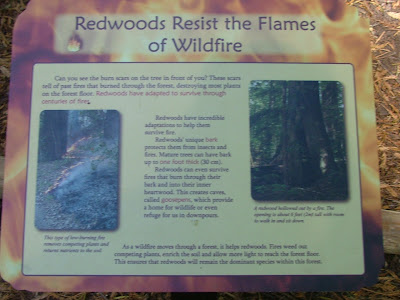
 They can be completely hollowed out by fire and/or rot and still thrive. They refer to these as 'goose-pens'.
 The cones are quite small. These are the champion comes for size: Colter Pine (R) and Sugarcone Pine (L).
 Colter Pine Cone.

As with the Sequoias, fallen logs can become Nurse Logs, hosting young trees.
 But much more often, new trees don't come from seeds at all. Some trees develop what they call Root Collar Burls, and new trees develop as shoots from these.


 Chapman's Gem & Mineral Museum and shop:

There are lots of geodes around, but this is pretty spectacular

 Barb with friend. They said this is a replica of the terracotta warriors in the Ming Tombs of China.
 Posters about a vaudeville star named Charles Kellogg. He got a single Redwood log and fashioned it into a truck, which he called the Travel-Log.
 Kellogg imitated all sort of birds and animals. He claimed to be able to sing tones too high for the human ear, extinguish flames by the strength of his voice, and be able to start the engine of the Travel-Log with his voice.

 These trees aren't as big as the Sequoias, but they're big. The bark is thick and ridged...
Which helps protect the tree from fire.

 They can be completely hollowed out by fire and/or rot and still thrive. They refer to these as 'goose-pens'.
 The cones are quite small. These are the champion comes for size: Colter Pine (R) and Sugarcone Pine (L).
 Colter Pine Cone.

As with the Sequoias, fallen logs can become Nurse Logs, hosting young trees.
 But much more often, new trees don't come from seeds at all. Some trees develop what they call Root Collar Burls, and new trees develop as shoots from these.


 Chapman's Gem & Mineral Museum and shop:

There are lots of geodes around, but this is pretty spectacular

 Barb with friend. They said this is a replica of the terracotta warriors in the Ming Tombs of China.
 Posters about a vaudeville star named Charles Kellogg. He got a single Redwood log and fashioned it into a truck, which he called the Travel-Log.Kellogg imitated all sort of birds and animals. He claimed to be able to sing tones too high for the human ear, extinguish flames by the strength of his voice, and be able to start the engine of the Travel-Log with his voice.


 This is Fern Canyon: An extraordinarily narrow canyon, completely sheltered by trees, and wonderfully peaceful.


 I n a couple of places the walls had absolutely no soil on them, so you get moss and lichens.


