


Starting Out Again II: Virginia, North Carolina

Sea Grove, North Carolina is a center of pottery-making; one specialty is Face Jugs. This is Dave's brother Jim & Ann's collection. (They're in Charlotte, NC).
After visiting Barb's cousin Stephanie and Mark Hudy and Uncle Adolf, in Harrisonburg VA, we stopped at Staunton (still in VA, in the Shenandoah Valley; please to pronounce it "Staantn"). Frontier Village represents the homeland of various US immigrants. This is a German farm, ca 1730, transported completely from the old country.
They had a bunch of chickens and a big kitchen-garden; the gentlemen below gave us some excess leeks, which we laater made into some excellent soup.
 VA, we stopped at Staunton (still in VA, in the Shenandoah Valley; please to pronounce it "Staantn"). Frontier Village represents the homeland of various US immigrants. This is a German farm, ca 1730, transported completely from the old country.
They had a bunch of chickens and a big kitchen-garden; the gentlemen below gave us some excess leeks, which we laater made into some excellent soup.

Next was the 1730 Northern Irish village, featuring sheep and weaving. In addition, they grew Oats, Rye and Barley; 15 A. of Oats were required to support a family. Later on, when potatoes were introduced, you could raise a family on 5 A. of potatoes.
The blacksmith (below) gave a sad story of government and taxes: everybody in Ireland was required to tithe - give 10% of their income - to the Established (Anglican) church, plus another 10% to his own Presbyterian church. Plus all the taxes to the govt. On Sunday everyone was expected to spend 10 hours at church. The Anglican churchwardens would patrol the town, and it they caught him working on Sunday, they'd drag him off to the Anglican church for the 10 hours; on top of that they'd fine him.


The blacksmith (below) gave a sad story of government and taxes: everybody in Ireland was required to tithe - give 10% of their income - to the Established (Anglican) church, plus another 10% to his own Presbyterian church. Plus all the taxes to the govt. On Sunday everyone was expected to spend 10 hours at church. The Anglican churchwardens would patrol the town, and it they caught him working on Sunday, they'd drag him off to the Anglican church for the 10 hours; on top of that they'd fine him.


This was an American barn, ca 1850. The machine there is a . To the left is Barb with a cheesepress. You put the cheese, full of whey, in there and tighten the screw.


The English farmhouse. Half-timbered, filled in between the timbers with mud & rushes.
Next, we went down the Blue Ridge Parkway to Asheville, home of the Biltmore estate. The first two generations of Vanderbilts made ferocious amounts of money, in steamships and railroads; the grandson, George Washington Vanderbilt, decided to concentrate on spending it. The idea was to establish a great landed estate like the great landed estates of England, which would last through geneerations. this he has done. It is the biggest private dwelling in the US; it includes a working farm, dairy farm etc. It is magnificently kept up.


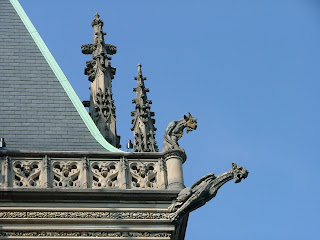
Next, we went down the Blue Ridge Parkway to Asheville, home of the Biltmore estate.
 The first two generations of Vanderbilts made ferocious amounts of money, in steamships and railroads; the grandson, George Washington Vanderbilt, decided to concentrate on spending it. The idea was to establish a great landed estate like the great landed estates of England, which would last through geneerations. this he has done. It is the biggest private dwelling in the US; it includes a working farm, dairy farm etc. It is magnificently kept up.


.Forestry: Biltmore is credited with initiating modern forestry. Their first employee was Gifford Pinchot, who founded the US Forest Service under Theodore Roosevelt.

Relaxing after a hard day of picture-taking and note-making.
After Biltmore: down the rest of the Blue Ridge Parkway to the Great Smoky Mountains.


 The French Broad River is the actual name; 'Broad ' is not another name for 'River". At one time it was the Broad River.


