

Houston: A city that doesn't mind mixing industry with urban life (unlike some of us wimps in the Northeast). And off to the Battle of San Jacinto, arguably one of the most important in our history, since it resulted in Texas being independent instead of a part of Mexico (which could easily have happened, as we'll see).
 Re-enactors
 Juan Seguin (with Barb). He led a group of Mexicans who wanted to fight with the 'Texicans'; Houston said, how will we tell you from the actual Mexicans in Santa Anna's army? Solution: the playing cards in their hats. Santa Anna wasn't all that popular, even in Mexico; he'd recently trashed the very progressive Mexican constitution and declared himself Emporer.
 A big help in the war was 'The Twin Sisters', two cannon donated by the citizens of Cincinnati, Ohio. All the artillery the Texicans had. Loading up...
 Getting reaqdy to fire - note guys holding their ears..
 Boooom! (My brother Jim, who reenacts Revolutionary War, says there are two kinds of reenactors: Those who are interested in history and those who like loud noises.
 More reenactors
 The flag: Nobody seemed to know who the lady is, or why she's dressed that way...Exemplifies Freedom of some sort, I guess.
 More reenactors
 A bullwhipper - you see he's wrapped the whip around the legs of the man on the right, who has his little kid in front of him. Deft. Btw, the crack of the whip is not from the end of the whip hitting itself, but from the end going supersonic. Supersonics in th 19th Century.
 A tomahawk thrower. They have separate tomahawk-throwing competitions, in which this guy competes.
 Hawking Barbecue Sauce...
 Yep, a flea circus. Of course, you pretty well have to take the guy's word as to whether the flea has actually done what he said it would...Naturally it ends up with a pitch for Chief Wahoo's Miracle Elixir.
 Or, you could buy a real branding iron, with your choice of brands, and brand your own cow or horse. What fun!
 A country band
 with what they called a finger piano.

Texans: Juan Seguin whom we've met, Sam Houston, and in white Deaf Smith, chief of scouts and a famous Mountain Man.
 Texican troops.
 General Santa Anna. He was 'President' of Mexico (actually dictator) eleven times - kept getting deposed and coming back; called himself the Napoleon of the West.
 Mexican troops; they were mostly conscripts. But they did get to wear neat uniforms.
 The Mexican cannon.


The foregoing was what happened on the first day of the battle: Mexicans fired artillery, Texans answered; Both sides advanced, fired rifle, then retreated, all at pretty long range; the cavalry skirmished inconclusively; nobody much git hurt; then both sides went into camp.
 And off to the Battle of San Jacinto, arguably one of the most important in our history, since it resulted in Texas being independent instead of a part of Mexico (which could easily have happened, as we'll see).
 Re-enactors
 Juan Seguin (with Barb). He led a group of Mexicans who wanted to fight with the 'Texicans'; Houston said, how will we tell you from the actual Mexicans in Santa Anna's army? Solution: the playing cards in their hats. Santa Anna wasn't all that popular, even in Mexico; he'd recently trashed the very progressive Mexican constitution and declared himself Emporer.
 A big help in the war was 'The Twin Sisters', two cannon donated by the citizens of Cincinnati, Ohio. All the artillery the Texicans had. Loading up...
 Getting reaqdy to fire - note guys holding their ears..
 Boooom! (My brother Jim, who reenacts Revolutionary War, says there are two kinds of reenactors: Those who are interested in history and those who like loud noises.
 More reenactors
 The flag: Nobody seemed to know who the lady is, or why she's dressed that way...Exemplifies Freedom of some sort, I guess.
 More reenactors
 A bullwhipper - you see he's wrapped the whip around the legs of the man on the right, who has his little kid in front of him. Deft. Btw, the crack of the whip is not from the end of the whip hitting itself, but from the end going supersonic. Supersonics in th 19th Century.
 A tomahawk thrower. They have separate tomahawk-throwing competitions, in which this guy competes.
 Hawking Barbecue Sauce...
 Yep, a flea circus. Of course, you pretty well have to take the guy's word as to whether the flea has actually done what he said it would...Naturally it ends up with a pitch for Chief Wahoo's Miracle Elixir.
 Or, you could buy a real branding iron, with your choice of brands, and brand your own cow or horse. What fun!
 A country band
 with what they called a finger piano.
Texans: Juan Seguin whom we've met, Sam Houston, and in white Deaf Smith, chief of scouts and a famous Mountain Man.
 Texican troops.General Santa Anna. He was 'President' of Mexico (actually dictator) eleven times - kept getting deposed and coming back; called himself the Napoleon of the West.
 Mexican troops; they were mostly conscripts. But they did get to wear neat uniforms. The Mexican cannon.
They had one neat wrinkle I haven't seen before: Just after the Texas cannon fired, a charge blew up in front of the Mexican one, like a real near-miss.


The Mexican infantry firing a volley...

and the Texans.

A cavalry skirmish.

The unseen hand - he explained everything that was going on, if you happened to be near enough to the loudspeakers.

The foregoing was what happened on the first day of the battle: Mexicans fired artillery, Texans answered; Both sides advanced, fired rifle, then retreated, all at pretty long range; the cavalry skirmished inconclusively; nobody much git hurt; then both sides went into camp.
That night, Santa Anna, convinced the Texans would attack at dawn, ordered his soldiers to sleep in formation on their arms. He woke them up at the crack of dawn and had them stand in ranks. By noon, the Texans hadn't gotten up. At that point, Santa Anna decided there wasn't going to be a battle that day, so he told the soldiers to stand down (they were all dead-tired, by then) and he retired to his tent without even bothering to post sentries (By the way, having already beaten the Texans several times, he had divided his forces into four columns, of which his was the smallest).
At about 4 PM, Houston finally decided to attack. The texans advanced clear to the Mexican tent; killed apout half of them and captured the other half, losing only two men killed; and captured Santa Anna himself the next day. Hoiuston got him to send a note to the other three columns telling them to gto home. So that was the end it; Texas, after what was really a pretty near-run thing, was independent.
 The final march-pasat: fifers
 Texans, including one Indian
Other stuff in Houston: The Menil Museum

With shrubbery


With shrubbery

Dinner with Barb's friend Denna (center), husband Nelson, and one of his associates (who was taking the picture).
 At teh Sam Houston Homestead: Old Sam hisself.
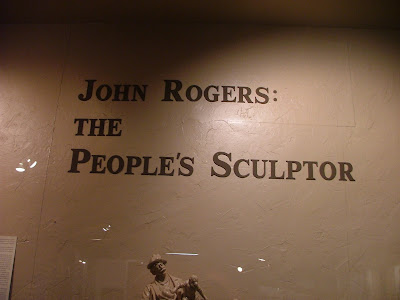
 And work of a guy I'd never heard of, John Rogers: Norman Rockwell in 3-D:
 "Checkers Down on the Farm"
 "The next Pew" - I call it "What hymn are we supposed to be singing, anyway?"
 "Visiting the Parson"
 General Grant explaining his plans to Lincoln and [Secretary of War] Stanton
 Othello: Cassio, Othello, SDesdemona and the snaky rat Iago off at the corner.

Lastly, the Johnson Space Flight Center (you know, "Houston, we've got a problem' and all that).

The International Space Station: One of the Russian modules

Two US modules:
 Banners of some of the other pqarticipants, which include Italy, Canada, Colombia, Brazil, Japan in addition to the US and Russia:

An astronaut practicing walking And a bunch of people watching him do it:
The manipulator arm, by Canada: The final version will have two identical endsw: One to attach to one of several docking points on the exterior of the ISS and the other to do work of attach itself to another point so the first one can detach and do something. Sort of like an inchworm:

The next generaqtion manipulator: It has eight legs, so naturally it's Charlotte as in Charlotte's Web:

The Space Shuttle: The pilot's station
 The experimenters' station
 A space meal (yum!)

 At teh Sam Houston Homestead: Old Sam hisself.
 And work of a guy I'd never heard of, John Rogers: Norman Rockwell in 3-D:"Checkers Down on the Farm"
 "The next Pew" - I call it "What hymn are we supposed to be singing, anyway?"
 "Visiting the Parson"
 General Grant explaining his plans to Lincoln and [Secretary of War] Stanton
 Othello: Cassio, Othello, SDesdemona and the snaky rat Iago off at the corner.
Lastly, the Johnson Space Flight Center (you know, "Houston, we've got a problem' and all that).

The International Space Station: One of the Russian modules

Two US modules:
 Banners of some of the other pqarticipants, which include Italy, Canada, Colombia, Brazil, Japan in addition to the US and Russia:
An astronaut practicing walking
 And a bunch of people watching him do it:
The manipulator arm, by Canada: The final version will have two identical endsw: One to attach to one of several docking points on the exterior of the ISS and the other to do work of attach itself to another point so the first one can detach and do something. Sort of like an inchworm:
The next generaqtion manipulator: It has eight legs, so naturally it's Charlotte as in Charlotte's Web:
The Space Shuttle: The pilot's station
 The experimenters' station
 A space meal (yum!)


 Old Trail Town, outside Cody
 The Grant-Coors Ranch, Wyoming. Didn't serve whole meals, but did have some suitably wild-and-wooly coffee.
 They had quite a collection of wagons.

 Montana State Historical Soc Museum
 Buffalo, on their best behavior, i.e. stuffed.
 Buffalo in the wild. There are quite a lot of them being raised now, partly for fun and partly for meat (interesting taste, but they will not replace cows in Big Macs any time soon).
 There are a lot of these around...
 Sheep, with a watch-llama.
 Waiting for a Big Mac at the drive-in window, Malta, Montana
 A hay-baler; not quite sure how it works. A lot of the land here is good for nothing much but Alfalfa hay, due to the short growing season. Some of has been irrigated at vast government expense; growing hay is costing the taxpayers a bundle.


 Each of the fallen soldiers is marked by a white stone.
 At some point, the Indians said "Wait a minute! We were here too. A few of us even got killed." So they changed the name to Little Big Horn Battlefield, and added a bunch of stuff about the Indians.
 A US soldier's gravestone, white.
 Fittingly, the Indians got red gravestones.
 They have a series of monuments listing all the tribes who fought here. One of the tribes not represented was the Crows, whose territory it was. They had decided, a few years before, that fighting the White Man was not a paying proposition in the long run.


